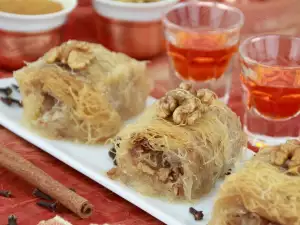
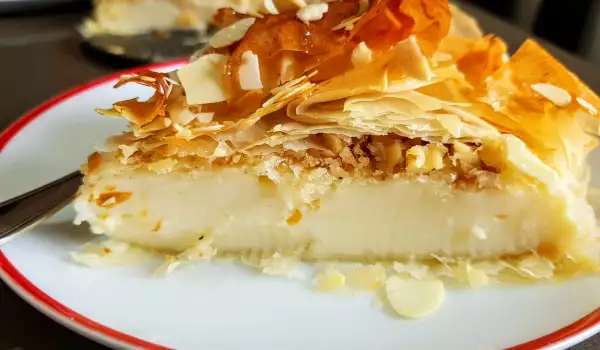
Bougatsa is a traditional Greek and Balkan custard pie made with delicate layers of phyllo pastry and creamy semolina or custard filling. This version adds walnuts, honey, and almonds for extra texture and richness.
Favorites
I made it
Add
Report
Preparation
20 min.
Cooking
40 min.
Тotal
60 min.
Servings
12
Crispy phyllo bougatsa filled with creamy custard, topped with walnuts, honey and almonds - a rich Mediterranean dessert.
Ingredients
phyllo pastry sheets - 270 g (9.5 oz), about 12 thin sheets
Prepare the cream filling by heating the milk over medium heat.
In a bowl, whisk the eggs and egg yolk with the sugar, cornstarch, and vanilla until smooth. If the eggs are small, add an extra yolk.
Slowly pour the egg mixture into the warm milk, whisking continuously for about 10 minutes until the cream thickens.
Melt the butter over low heat and grease a 28 cm (11 inch) baking pan.
Place one sheet of phyllo so that the edges hang over the sides of the pan. Brush generously with melted butter. Lay a second sheet crosswise on top and brush again with butter. Repeat this process with 6 sheets total.
Pour the custard cream into the center and spread evenly.
Layer the remaining 6 sheets on top using the same buttering method.
Mix the chopped walnuts with 1-2 tbsp sugar and spread evenly over the final sheet.
Fold the overhanging edges inward toward the center.
Brush the top with the remaining melted butter.
Bake at 180°C (350°F) in a preheated oven for about 25 minutes, or until golden brown.
Allow the bougatsa to cool, then brush the top with honey and sprinkle with lightly toasted sliced almonds.
Bougatsa is a traditional Greek pastry made with layers of crispy phyllo dough wrapped around a sweet or savory filling. The sweet versions often include custard or nut-based fillings such as walnuts and almonds.
Where does bougatsa originate from?
Bougatsa originated in northern Greece and is especially associated with the cities of Serres and Thessaloniki, where it became a famous local specialty.
What type of dough is used in bougatsa?
Traditional bougatsa is made with thin layers of phyllo pastry, which become crispy and golden when baked.
Is bougatsa a dessert or a savory dish?
It can be both. Some versions are filled with sweet custard or nuts, while others contain cheese, meat, or spinach.
How is bougatsa usually served?
After baking, bougatsa is typically cut into pieces and served warm, often dusted with powdered sugar and cinnamon.
Is bougatsa eaten for breakfast?
Yes. In Greece it is commonly enjoyed as a breakfast pastry or a mid-morning snack with coffee or tea.
What texture should bougatsa have?
A good bougatsa should have a crispy, flaky phyllo crust on the outside and a soft, flavorful filling inside.
Are there regional variations of bougatsa?
Yes. Different Greek regions prepare bougatsa with different fillings and sweetness levels, depending on local traditions.
Can bougatsa be made with nuts like walnuts and almonds?
Yes. While custard is the most common filling, some versions include chopped nuts such as walnuts and almonds for a richer flavor and texture.
How long does bougatsa stay fresh?
Bougatsa tastes best when served warm shortly after baking, while the phyllo pastry is still crispy.
In the US and UK, phyllo-based desserts are especially popular in Mediterranean-inspired kitchens and bakery-style home cooking. This walnut and almond bougatsa combines crisp, buttery layers with smooth custard and a nutty topping, making it perfect for brunch, holiday gatherings, or afternoon tea.
It can be served warm or at room temperature and pairs beautifully with coffee or espresso.